Affect and Form: Suppressed Order, Interfering Order

The sense of fullness I experienced at the Acropolis of Athens and the Temple of Olympian Zeus
was not something that could be understood through an analysis of proportion.
The sensory beauty captured in Greek art has long been translated into structural terms such as proportion and balance. But more than a decade ago, through an accidental experience, I had already sensed that there exists a fundamental aesthetic consciousness within us.

37 Minutes, 3879 Strokes suppresses the will toward form through the repetition of actions within a limited duration. Yet the irregular rhythm of short strokes reveals an unintended density of the surface and a different kind of order. It is a paradox in which an attempt to control structure produces another form of order.
Robert Morris, 37 Minutes, 3879 Strokes, 1961
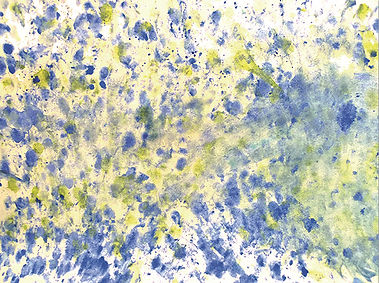
In d-17, order is not constructed. It is interfered with. Instead of installing a device to suppress order, I blocked structural intention altogether through the accumulation of sixteen uncontrolled layers of dripping. Fragments of paint falling from a fixed height spread and dispersed through water, interfering with one another. And with each new layer of dripping laid over them, they penetrated one another again. Time leaves traces across the surface, continually unsettling the relationships among the events that have taken place. Some may interpret these results in formal terms or associate them with certain images. But such readings are merely the inertia of perception and cognition at work.

Sangghil Oh, d-17, acrylic with water on paper, 130 x 80 cm, 2019


D-17 process,
February 14, 2019
D-17 process,
March 15, 2019
Morris, through the constraint of time, and I, through the uncontrollable contingency of dripping, both removed formal intention and narrative. And yet, if a certain aesthetic response still arises from these works, it may belong to a different register from what has been learned as form.
What is it?
And what potential does it hold?
A drawing made by a first-grade child, who “played” the piano in color while listening to a piano sonata, reveals a clue. There is no formal training, no intention of composition, no judgment guiding the process. And yet, within that drawing, rhythm, density, and a sense of fullness are clearly present. Standing before it, I felt shaken at the root, and sensed that it marked a point from which I had to begin again.
_%EA%B7%B8%EB%A6%BC%EC%9E%90.jpg)

Finger Piano (Moonlight), 1st Grade, Seongsan Elementary School, 2010
Since that day, I have continuously questioned the formal order I had learned.
And in 2019, in a corner of a storage space, I dismantled it completely.
Order does not reside within analyzed structures. It is more likely something that has always formed itself within larger systems or at smaller scales. Like the planets in the solar system, like countless orders found in nature, beauty too may emerge from the interaction of sensation, material, and time.
To understand this,
we must return to the very ground
of what we have long assumed as formal order.
Does form truly exist—
or is it a translation of affect?
This is not a question about form
as a vessel of beauty.
But about what we perceive as beautiful—
and why it matters.
It is a return to that question.