top of page
1996 getto.jpg
1996 getto01.jpg
getto05(small).jpg
GHETTO1 copy.jpg

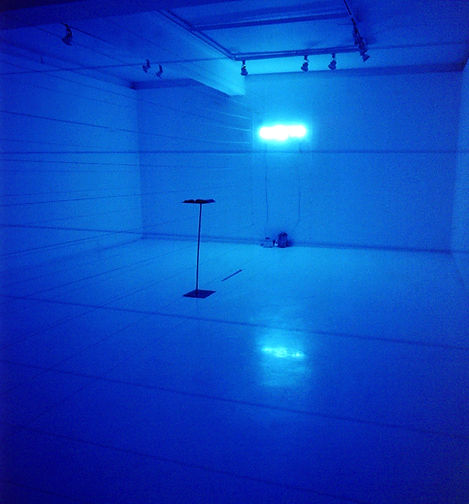
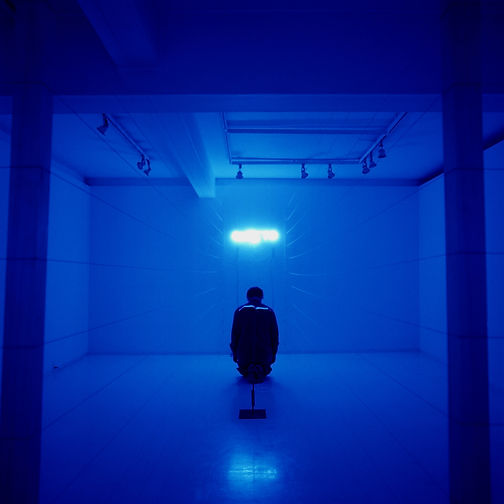
<Epilog, “Łódź Ghetto”>, Opening Performance, 1996, steel wire, electricity, voltage regulator, neon, blacklight, bible, etc.

MARU –The Fifth Point Touched by the Wind

Addendum to the work

On the Unspoken Work

Epilog, “Łódź Ghetto”

Artist’s Position

I do not believe that nationality holds decisive meaning for an artist. Rather, I see the artist as an existence open—both synchronically and diachronically—to all times and events of the world. My concerns are not limited to the history or people of the country in which I was born, but extend to humanity as a universal condition and to history in its entirety. There is no reason to confine one’s attention to a single nation simply because of one’s origin.

Background of the Work

In late 1987, during a journey undertaken amid deep personal questioning, I visited the Dachau Memorial near Munich. There, I confronted the terrifying nature of human beings. It was an encounter with the fundamental conditions of humanity—suffering, oppression, silence, memory, and resistance—entangled in a form that humanity has repeatedly shared throughout history.

Łódź is the name of a city in Poland where the Nazis established the first ghetto for Jewish people.

Epilog, “Łódź Ghetto”

Epilog was an attempt to face this condition. It was neither a historical reconstruction of the Łódź Ghetto nor an effort to draw the tragedy of the Holocaust into a grand narrative. What I sought to address was the human condition under absolute power—such as the state or ideology—where the human body, speech, and memory are erased.


Installation

By layering disparate sensory elements—black light, steel wire, wood, the Bible, and neon—within an enclosed space, I aimed to create a liminal environment in which viewers could no longer clearly locate their own bodies. Rather than reproducing a specific historical site, the installation functioned as a device that sensorially revealed how oppression, silence, and fear impose a particular temporality upon human beings.


Performance

The space was divided by steel wires, forming two prison-like enclosed areas with a narrow passage between them. Electric current was run through the wires, and during the opening performance, metal objects came into contact with the wires, producing sparks and bursts of light.

This staged an event of body–space–electricity–danger–unspoken energy. It was a sensory experiment in which viewers were confronted with the hazardous voltage of an oppressive space, drawn into an experience that symbolized control and surveillance, confinement and isolation, threat and intimidation. The passage became a boundary that was difficult—or forbidden—to cross.

Though thin, the countless steel wires segmented the space into a single, highly charged structure. It was ambiguous who was trapped inside and who was observing. Dark, bluish, cold, and melancholic, the space evoked unease—not a site of quiet remembrance, but a dangerous zone holding a voltage that could erupt at any moment.


Performance as a Temporal Epilogue

This performance functioned as a temporal epilogue. The moment electricity flowed, the installation transformed into a site where pressure, control, danger, and silence converged. The performance became a device that revealed how the space itself operates—allowing viewers to experience that historical violence is not concluded, but continues to repeat within the sensory present.

Within the pressure of dark blue black light and a space charged with cold, melancholy, and anxiety, I staged what might be called an “extreme performance within restraint.” Through a body that dreams of repentance, prayer, and flight, the work unfolded as something akin to a ritual—an act in which a human body, in darkness, connects itself to the residual fragments of the world.

Epilog, “Łódź Ghetto”

The essence of this work does not reside in a static object, but in its transformation into a temporal event—one in which darkness, voltage, air, body, movement, sparks, and silence momentarily converge. Rather than representing memory or history, the work proposes the conditions under which they become operative as present events.

This work is not an object but an event. Through the artist’s body as a performative medium, and the audience’s body as a co-producer of the event, Epilog, “Łódź Ghetto” activates history within the present tense.

08.JPG
09.JPG
07.JPG

Da Chau Memorial, 1988

Art as an Unspoken Event

— Theoretical Reflections on Epilog, “Łódź Ghetto”

Epilog, “Łódź Ghetto” does not attempt to reconstruct a historical tragedy, nor does it seek to organize memory into a coherent narrative. What the work addresses is the condition prior to representation: the moment in which human beings become unable to speak, when the body is reduced—under political and ideological pressure—to a bare, exposed state of existence.

Rather than explaining this condition, the work activates it.


1. The State of Exception and the Condition of Speechlessness


The historical reference invoked by Łódź Ghetto does not function as a specific place or event to be reenacted. Instead, it points to a structural condition in which human beings are expelled from the sphere of legal protection and political recognition. This resonates with the notion of the state of exception articulated by Giorgio Agamben, yet Epilog does not translate this concept into theory. It renders it corporeal.

The electrified steel wires form a boundary that is simultaneously visible and inaccessible, a zone where danger is not symbolic but imminent. Viewers do not interpret this boundary; they calculate it with their bodies. At this threshold, the human subject no longer appears as a citizen or moral agent, but as an exposed body, vulnerable to injury. Silence here is not a metaphor—it is the condition under which speech becomes impossible.


2. After the Banality of Evil: A Space Without Clear Responsibility

Hannah Arendt’s insight into the banality of evil shifted attention away from monstrous perpetrators toward systems that function without reflection. Epilog constructs such a system spatially. It offers no clear distinction between victim and observer. It becomes uncertain who is confined and who is watching.

This ambiguity does not suspend ethical judgment; it exposes how responsibility dissolves within functioning structures. Under the cold, bluish pressure of black light, viewers are compelled to ask:

Am I observing this structure, or am I already embedded within it?

The question resists resolution. It mirrors the condition Arendt described as thoughtlessness—not as ignorance, but as the smooth operation of systems in which thinking is no longer required.


3. From Disciplinary Space to Event-Space

The segmented space of steel wires inevitably recalls the disciplinary architectures analyzed by Michel Foucault—spaces structured by surveillance, division, and control. Yet Epilog diverges from stable regimes of discipline. This is not a managed institution but an unstable environment, charged with the constant possibility of accident.

The sparks produced during the performance are not symbols. They are events—moments when suppressed energy breaches the surface. In these moments, the installation transforms into a temporally volatile field. Power is no longer abstract; it is felt directly on the skin, in the nerves.


4. Memory Beyond Representation: History as Present Event

Epilog, “Łódź Ghetto” does not preserve memory. It constructs the conditions under which memory re-emerges as a present event. History here is not fixed in the past; it re-enters the present through specific sensory conditions—voltage, darkness, silence, bodily tension.

Art, in this work, does not function as testimony. It becomes an environment. The artist’s body operates not as an expressive subject but as a performative conduit, while the audience’s bodies shift from spectatorship to co-production of the event. The work offers no moral lesson. Instead, it leaves behind an irreducible sensation: this can happen again.


Conclusion

Epilog, “Łódź Ghetto” is political without being didactic, historical without being representational. The work does not articulate what cannot be spoken, nor does it visualize what cannot be shown. Instead, it exposes the conditions under which silence, danger, and control come into operation.

In those conditions, a question inevitably arises:

What can art do when speech becomes impossible?

Epilog answers without explanation.


Art does not explain. Art produces events.

This is where the conversations of MARU end.

You may now see and hear the Artist Eassy—with a different time, a different body,a different silence and a Position.

  • Facebook
  • Twitter
  • LinkedIn
  • Instagram
bottom of page