Creation as Repositioning
On Structure, Relation, and Return
I. Redefining Creation in a Saturated Field
The twenty-first century has fundamentally altered the conditions under which art operates. The overproduction of images and the expansion of media technologies have enabled formal innovations to be rapidly absorbed by institutions, destabilizing the status of “newness.” In this environment, the modern model that understands creation as invention ex nihilo has gradually lost its persuasive force.
This essay proposes to understand artistic creation not as the production of form but as the reconfiguration of position within a relational field. I call this “repositioning.”
Repositioning is a structural operative principle that moves existing forms, contexts, and discourses into new coordinates, thereby exposing the conditions under which meaning emerges. It suggests that artistic innovation has depended less on material rupture than on how relationships between object and context, artist and institution, perception and discourse are reorganized.
Its core methodology is “re-reading”: the act of placing past works and events back into the present relational field. Through re-reading, creation is understood not as a fixed form but as a structure continually reconstituted.
II. The Invention Model and the Structural Difference of Artistic Creation
In science and technology, invention is understood as the production of new materials or functions. Artistic “newness,” however, often arises when identical forms are repositioned within different coordinates, producing shifts in meaning.
Originality cannot be reduced to the creation of unprecedented forms. To equate art with the logic of scientific innovation risks oversimplifying its distinct mode of operation.
Repositioning must also be distinguished from appropriation or recontextualization. It is not merely the borrowing of objects or the adjustment of context. Rather, it shifts the relational network itself, revealing the structure through which meaning is generated. The issue is not form, but position; creation operates through the reconfiguration of the relational field.
III. Case Studies — The Structural Operation of Repositioning
1. Repositioning Authorship — The Transfer of Name
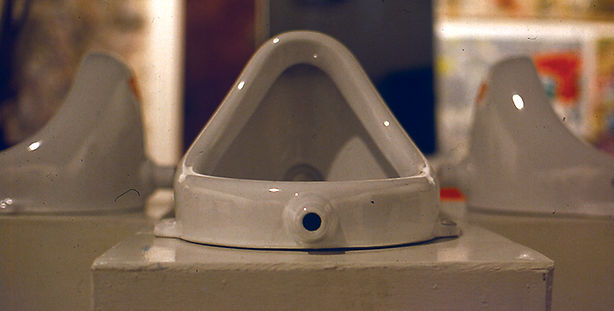
In 1985, I submitted four urinals under the name of Marcel Duchamp. This was not parody, but an attempt to reposition the strategy of the readymade itself.
Duchamp’s Fountain (1917), along with its accompanying controversy and the text published in The Blind Man, was initially conceived as a shock to the boundary between art and the everyday. Yet as the event became institutionalized, the object was stabilized within art history, producing what might be called a “bug” of conceptualization.
My gesture attempted to reverse this stabilization—to return the readymade from its conceptual closure to an event. By placing the urinal within a different relation of authorship, the axis of meaning was shifted. Authorship was revealed not as essence but as an effect of placement.

Fig. 1. Marcel Duchamp, Fountain, 1917.
.jpg)
Fig. 2. Sangghil Oh, fountain–false–fable–four, Four Urinals, 1985
2. Repositioning the Object — Installation and Return
In 1989, I temporarily installed natural objects borrowed from nature in exhibition space and returned them to their original site immediately after the exhibition. This too was grounded in repositioning.
By installing “natural” objects without modification, I minimized formal intervention and emphasized that an object operates as art only under specific relational conditions. Positioned at the boundary between art and non-art, the object remained materially unchanged. Its status as artwork was contingent upon the relational structure in which it was placed.
Once dismantled and returned, the work resumed its existence as an ordinary object, continuing its process of natural decay. This process reaffirmed that the work was not a fixed entity but an event of repositioning. Preservation, collection, and ownership were thus displaced. The work endured not through physical conservation, but through relational memory and the possibility of repeated repositioning.
The fact that this practice continued consistently until 1996, and that the same work could be re-installed under different sensory and temporal conditions in exhibitions at MMCA in 2010 and 2020, demonstrates that repositioning was not a singular experiment but a sustained operative principle.

Fig. 3. Sangghil Oh, Untitled-89-2, 1989.
Fig. 4. Sangghil Oh, Untitled-89-2, 2020

Furthermore, in Hairlines of Control (1993), where the hair of prisoners was lined up on the exhibition floor accompanied by the sound of amplified heartbeats and the pungent scent of unwashed bodies, repositioning extended into the realm of raw human traces and social discipline. It demonstrated that repositioning is not an abstract exercise but a visceral confrontation with the existence within institutional structures—a refusal to let sensation be neutralized by the 'refinement' of the gallery space.

Fig. 5. Sangghil Oh, Hairlines of Control, 1993
3. Repositioning Temporal Structure — The Principle of Arrangement
Time in art has often been structured through narrative progression or rhythmic repetition. Robert Morris’s 37 Minutes, 3879 Strokes (1961) reduced gesture to measurable units, repositioning action as structural arrangement rather than expression. Time became quantifiable rather than experiential flow.
In contrast, my Random Series, Flash MX (2004) reconfigured temporal coordinates through an algorithm based on irrational numbers. Non-repetitive frame sequences disrupted linearity and periodicity. What mattered was not the image itself but the principle of arrangement. The same frames produced entirely different perceptual effects depending on their ordering. Time was experienced not as natural duration but as a constructed condition.


Fig. 7. Sangghil Oh, random fuck, 2004.
Robert Morris, 37 Minutes, 3879 Strokes, 1961.
4. Repositioning Art Historical Narrative — Re-reading as Practice
Conventional art historical coordinates rely on hierarchies of center and periphery, and on developmental narratives. Within this framework, experimental Korean practices were often positioned as either belated receptions or isolated precedents.
Repositioning operates not by revaluing individual works but by shifting the narrative structure that positions them. In 2004, I re-read Lee Seung-taek’s Wind (1971) not simply as dematerialization but as a displacement of the coordinates through which “materiality” operates. Likewise, Kim Kulim’s From
Phenomenon to Trace (1970) was repositioned not merely as early conceptual art but as an event restructuring the relation between time and trace.
Re-reading does not revise the past; it relocates it within the present relational field. Contemporaneity thus becomes not temporal simultaneity but a matter of structural reconfiguration.

Fig. 8. Seung-taek Lee, Wind, 1971.

Fig. 9. Kulim Kim, From Phenomenon to Trace, 1970/2001.
5. Repositioning Knowledge Infrastructure — Re-reading Korean Contemporary Art
If the previous examples repositioned works and experiences, the long-term project Re-reading Korean Contemporary Art (2000–2017) attempted to reposition the knowledge structure that frames art itself.
Where conventional narratives explained Korean art through Western theoretical frameworks, this project sought to move the coordinates of historical narration. It involved the collection and reclassification of primary sources, in-depth dialogues with artists and critics, public symposia, research exchanges with Japanese Mono-ha scholars, curated exhibitions, and the publication of eleven volumes.
Here, re-reading expanded from interpretation into structural rearrangement of discourse, extending repositioning to the infrastructural level of knowledge production.
IV. Repositioning as Infrastructure
These cases demonstrate that repositioning operates as a structural principle across authorship, materiality, temporality, historical narrative, and knowledge infrastructure.


Fig. 10. Re-reading Korean Contemporary Art Symposium.
Fig. 11. Re-reading Korean Contemporary Art Archive Series
In the contemporary environment, formal innovation is rapidly neutralized. The invention model demands constant differentiation, yet difference is swiftly consumed. Repositioning does not produce more forms; it shifts the coordinates in which forms operate. It does not increase material output but reconfigures the structure of meaning.
Infrastructure is rarely visible, yet it enables flow. Repositioning designs the field in which works, discourse, history, and perception intersect. Creation, therefore, is not synonymous with invention. It is the structuring and redistribution of positions within relational fields.
Repositioning does not eliminate sensation. On the contrary, by shifting structure it exposes the site of perception itself. Art becomes not a fixed form but an event continuously re-read. Re-reading becomes a productive act, and repositioning the condition that sustains it.
Repositioning is not a style of 21st-century art. It is a condition—an infrastructural energy that enables art to renew itself continuously.