When the Brushstroke Stops Being a Unit
For decades, I have repeatedly asked whether art is still operative.
The absence of shared criteria, language, or a unified aesthetic horizon
means that art must continually prove itself through the way it operates.
What matters is not what appears as art,
but questioning its mode of existence and operation.
The artist must locate that answer within the work itself.
This text began with Sol LeWitt’s Brushstrokes.
Though it appeared visually similar to my own drawings,
I sensed a certain productive tension within it—
like encountering a real rose among ornate paper ones.
In that moment, Robert Morris and Lee Ufan came to mind.
A dialogue seemed possible.
In LeWitt’s work, the stroke operates as a repetitive module,
immediately forming a structure as a conceptual unit.
In Morris, the stroke accumulates through duration,
registering time as repeated action.
In Lee Ufan, repetition also constructs structure,
but within controlled intervals that sustain it.
Each of these artists demonstrates a distinct unit of the stroke.
However, I believe that under certain conditions,
this unit can no longer be maintained—
it collapses before it is even recognized as such.
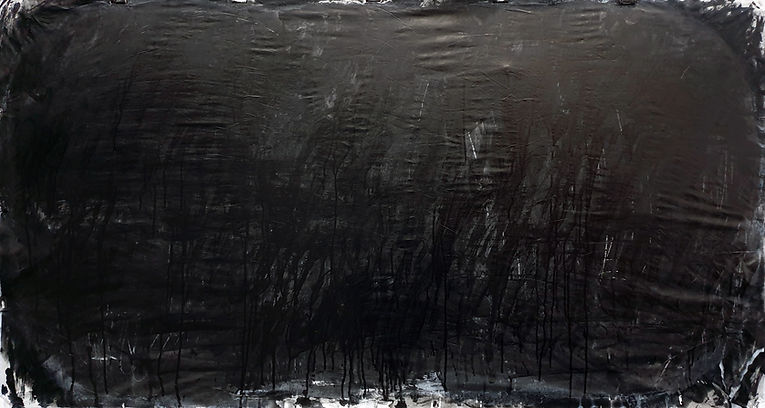
This drawing was produced under conditions that disrupt that stability.
Instead of preparing the canvas to hang on a wall,
I laid it flat on a table.
Paint was heavily applied to the upper edge,
water was sprayed across the surface,
and a portion was slowly drawn downward with a brush.
Rather than compositional intention,
gravity, water, and time intervened,
producing irreversible phenomena beyond my control.
Sangghil Oh
d-220, oriental ink on paper
2020
The surface was filled with what could neither be drawn nor represented,
and the image remained not as a point of departure,
but as a result.

Sangghil Oh
untitled, acrylic with water on canvas
2026
This is not a transformation of painterly language.
It is the design of conditions in which physical phenomena,
rather than intentional strokes, construct the surface.
— Not a return to any prior state,
but the opening of conditions in which such a state may occur.
In this case, the brushstroke no longer operates as a unit.

Sangghil Oh
untitled, charcoal & gesso on pqper
2026
Each event is materially and temporally singular,
and therefore cannot be repeated.
Without stable elements, it cannot be modularized.
Exceeding intention, it cannot be controlled.
The brushstroke remains not as a means of representation,
but as a physical event.
Before repetition.
Before structure.
Before form.
This drawing does not present an image.
It only reveals the conditions under which something occurs.
If repetition produces structure,
this work begins at the point where structure can no longer be sustained.
If the brushstroke was once the minimal unit of painting,
this work departs from the moment that unit collapses.
References:
Sol LeWitt, Brushstrokes, 1990s
Robert Morris, 37 minutes, 3879 strokes, 1961
Lee Ufan, From Line, 1979